December 2025
Christmas has a long Christian tradition throughout Europe, with each country having their own unique take on the holiday. We have many Christmas tradtions that we know as classic traditions, that have their origins in Germany. Here are a select few that you might already do or may decided to incorporate into your family Christmas traditions.
Advent Calendars
Advent calendars were used to count the days of Advent, a period of anticipation and preparation in the 4 weeks leading up to Christmas. It was first used by German Lutherans in the 19th century. Advent calendars started as simple lines or candles tracking the days. Around 1850, they began making Advent calendars that included treats, bible verses, or drawings
Krampus
Krampus is a horned anthropomorphic figure who, in the Central and Eastern Alpine folkloric tradition, is said to accompany Saint Nicholas, who gave small gifts on the eve of Saint Nicholas Day (December 5th). Well-behaved children were awarded with small gifts by Saint Nicholas, while Krampus threatened to hit them with a switch or shove them in his bag. The origins of Krampus are unclear, and some suggest the story comes from pre-Christian times.
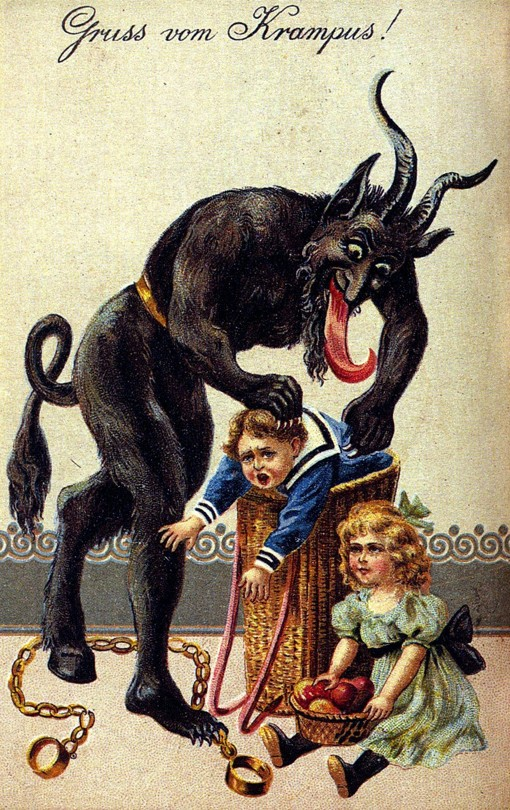
Image from https://en.wikipedia.org/wiki/Krampus#/media/File:Gruss_vom_Krampus.jpg
Nutcrackers
Nutcrackers originated in the late 17th century in the German region of Erzgebirge. They began as functional tools and evolved into decorative figures, usually soldiers or kings. Friedrich Wilhelm Fuchtner began mass-producing nutcrackers in 1872, creating the iconic standing soldier design. The Nutcracker ballet by Tchaikovsky, based on E.T.A. Hoffmann’s story, popularized the toy. It was further popularized after World War II when American soldiers brought them home as souvenirs.
Christmas Tree
Christmas trees originated in Germany, where they were called “Christbaum”, but the exact reason for the tradition remains uncertain. One possible origin is the medieval Paradise Play, which told the story of Adam and Eve and included a tree decorated with apples. These trees, nicknamed “paradise trees”, were set up in homes on the feast day of Adam and Eve (December 24th). Paradise trees would be decorated with more than just apples, including paper roses, wafers, and candies. These trees tended to be small enough to place on a table or hang from the rafters; it wasn’t until around 1850 that full-sized trees became the norm. The transition to full-sized trees led to a demand for ornaments; before 1850, homemade decorations were used. Germany would grow an industry to meet this demand. The practice of “Christbaum” was brought to North America by German emigrants, becoming widespread in Canada by 1781.
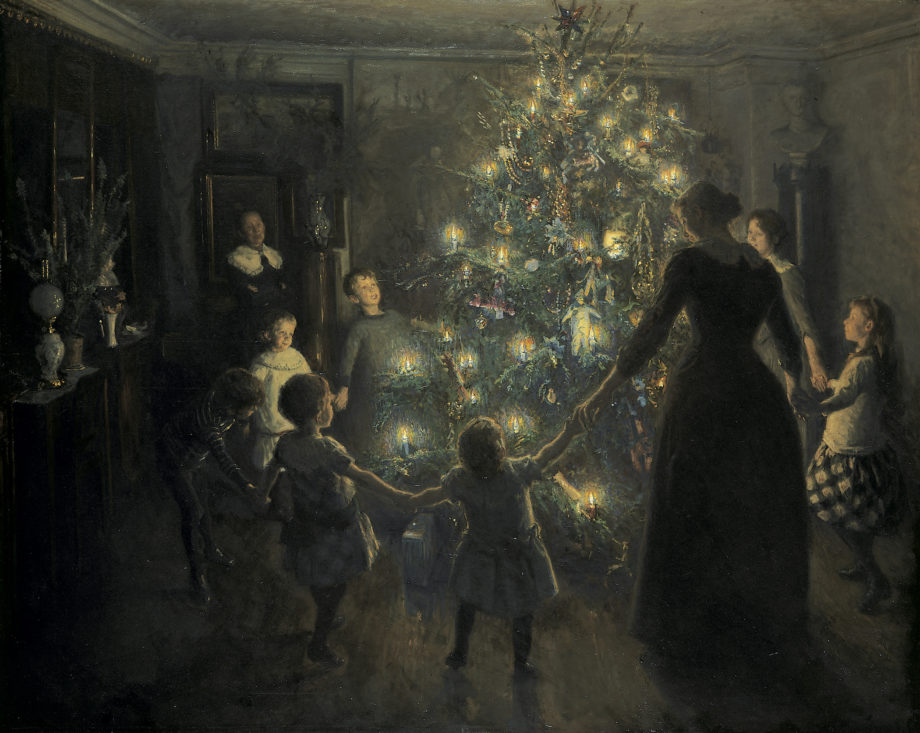
Image from https://en.wikipedia.org/wiki/Christmas_tree#/media/File:Johansen_Viggo_-_Radosne_Bo%C5%BCe_Narodzenie.jpg
Stockings
Stockings likely originated from a myth of Saint Nicholas. The myth goes that there were three daughters of a poor man who would never be able to marry because they had no dowry. Saint Nicholas dropped three golden balls, one for each daughter, into their stockings that were hanging up to dry. So people hung up their stockings, hoping Saint Nicholas would drop a present inside. Before the 19th century, stockings were the main place for presents to be left, rather than under a Christmas tree. They would be hung on the fireplace, window, or at the foot of one’s bed. England and some Commonwealth countries use pillowcases as their stockings.